Schlagwort: OER

  • OER im Blick – Eindrücke von der Auftaktkonferenz 2024

    OER im Blick – Eindrücke von der Auftaktkonferenz 2024

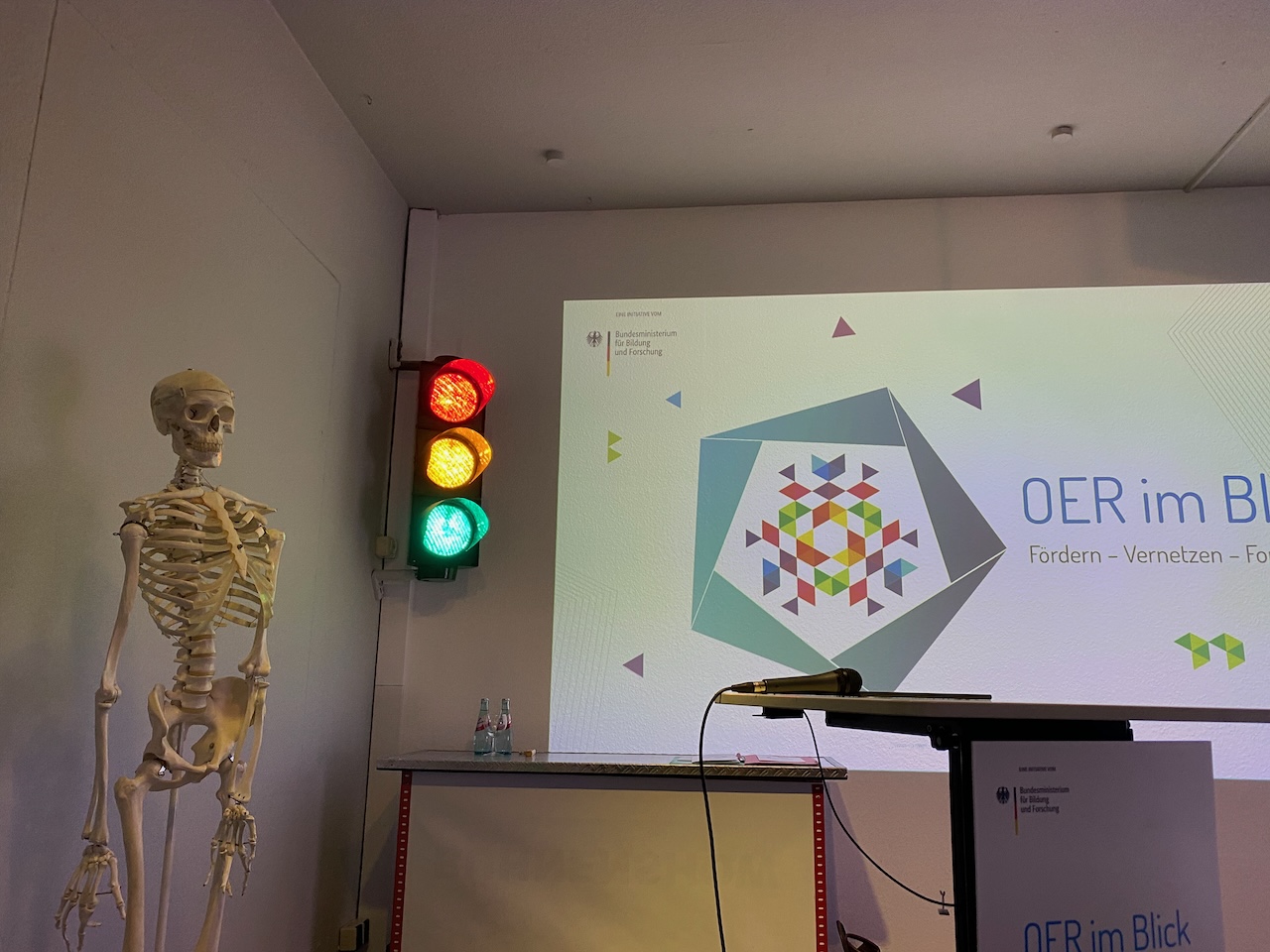
    Am 15. und 16. Mai 2024 luden das BMBF und der DLR zur Auftaktkonferenz „OER im Blick“ nach Frankfurt / Main ein. Mit dieser Veranstaltung sollten die Aktivitäten zur Umsetzung der OER-Strategie beleuchtet und mit der Community diskutiert werden.

    Die Community

    Mit der ersten Fördermaßnahme im Rahmen der OER-Strategie setzte das BMBF auf den Auf- und Ausbau von Communities, die den OER-Gedanken und OER-Kompetenzen in bestimmten Fächern verbreiten und etablieren sollen. Das Spektrum ist breit gestreut und fokussiert auf Lehrkräftebildung, Bildung für nachhaltige Entwicklung oder Rechtswissenschaft.

    In den Konsortien finden sich zum teil sehr OER-erfahrene Menschen und „Newbies“, die gemeinsam das Ziel verfolgen, mit OER die Bildungswelt etwas besser zu machen.

    Die Locations

    Die Auswahl der Locations verfolgte offensichtlich der Strategie „Raum als dritte/r Pädagog/in“ und lud zum Austausch mit bekannten und neuen Gesichtern ein. Am ersten Tag bzw. Abend stand eine Gruppenbildung im Science Center Experimenta auf dem Programm und die Diskussion von OER-spezifischen Fragen. Begleitend konnten die Stationen mit physikalischen Experimenten ausprobiert werden. Ein gemeinsames Abendessen mit original grüner Sauce rundeten den Tag gebührend ab.

    Außergewöhnlich ging es am Morgen danach weiter in den Räumlichkeiten des Kunstvereins direkt am Main-Ufer.

    Standortbestimmung

    Das offizielle Programm begann nach einer kurzen Begrüßung mit einer Podiumsdiskussion und der wahrscheinlich nicht so ketzerisch gemeinten Fragen: Warum sind wir mit OER noch nicht weiter?

    Konsens bestand, dass die Annahme einer sprunghaften oder gar revolutionären Verbreitung von OER und der damit ausgelösten Reform des Bildungssystems völlig am Thema vorbeigeht. Unterstellt würde damit, dass es eindeutige Ansatzpunkte gibt, mit denen OER-hemmende oder -verunmöglichende Rahmenbedingungen mit einem Schlag ausgeräumt werden.

    Stattdessen ist es sinnvoller und ermutigender auf die Errungenschaften der letzten zehn Jahre zurückzublicken. Das betrifft zum Beispiel:

    • eine stabile und wachsende Community; als Indikator können die Teilnahmezahlen an den OERCamps dienen
    • politische Rahmenwerke wie die OER-Strategie des BMBF, OER-Policies an Hochschulen oder dass OER in bildungspolitischen Papieren regelmäßig genannt wird (z.B. Wissenschaftsrat 2022)
    • technische Infrastrukturen wie den Suchindex OERSI, Repositorien, OER-Portale, OER-Funktionen in LMS etc.; tatsächlich hat sich die Infrastruktur in den letzen 20 Jahren sehr ausdifferenziert, wie in dieser Studie kürzlich gezeigt wurde
    • OER-Förderung: so gab es etwa in NRW sagenhafte 27 Millionen EUR für die Erstellung von OER (siehe für eine Förderlinie hier)
    • Aufbau von OER-Netzwerkstrukturen: auch hier setzte NRW einen starken Impuls mit der Förderung des „Netzwerk Landesportal“ im Bereich der Hochschulen

    All das sind kleine Mosaiksteine, die sich nach und nach zu größeren Einheiten zusammensetzen und dadurch mehr Wirkung und mehr Sichtbarkeit erzielen. Gleichzeitig zeigt ein Rückblick, dass die Herausforderungen und Probleme in der Gesellschaft und im Bildungssystem dramatisch zugenommen haben. Es eröffnet sich ein Spannungsfeld zwischen Verzwergung („wir trauen uns nicht an die wirklich dicken Bretter ran“; „wir haben keine Vision“) und Selbstüberforderung („wir nutzen OER als Allheilmittel“).

    Eine realistische Einschätzung der Wirkungsmöglichkeiten von OER bedeutet ein Einpendeln zwischen den beiden Polen. Ein konkretes Beispiel aus dem Podium möchte ich hier nennen: Schulbücher vermitteln nicht nur fachliche Inhalte sondern reproduzieren auch gesellschaftliche Stereotypen oder Rassismus. Mit OER, die zu einem digitalen Schulbuch zusammengesetzt werden, kann gezeigt werden, dass Inhalte auch außerhalb von Verlagen qualitätsgesichert erstellt und distribuiert werden. Gleichzeitig lässt sich demokratiegefährdenden Tendenzen entgegenwirken.

    Wie geht es weiter?

    Die BMBF OER-Strategie ist auf zehn Jahre angelegt und soll mit der Community ausgestaltet werden. Zunächst werden verschiedene Übersichten erstellt von Communities, von OER-förderlichen Infrastrukturen, um mehr Transparenz zu erzeugen. Auch die OER Worldmap ist wieder da und nächstes Jahr gibt es eine neue Konferenz „OER im Blick“.

  • On the role of openness in education

    It’s an hour for me to be one of first authors of the brand new journal Open Praxis with the paper „On the role of openness in education“ that I have written together with my colleague Sandra Peters (University of Technology Sydney). It covers much of her PHD work on the historical research in education. Based on this we go on to argue

    After a period of open movements many times there have been slight but important shifts from “pure” openness towards “pretended” openness, i.e. some aspects have been modified to offer more control for producers and other stakeholders. For instance, the historic culture of the coffeehouses had been transformed to private clubs and closed, exclusive societies. The original MOOC concept has been utilised for the development of platforms like Udacity or Coursera both of which are providing free courses containing material that cannot be adapted according to the 4Rs (see above). Similarly, Open Study is a for profit platform. History emphasizes the risk in failing to preserve the openness that made initiatives successful in the first place. The development of free but not entirely open courses needs to be examined more closely. While not immediately altering public perception, the shift from humanistic values to more “efficient” and “productive” educational opportunities can undermine the significance of openness.

    Full text is available here. Looking for your comments.

  • A bigger picture on MOOCs

    I was pointed to the above info graphic and asked for a brief review, so I am happy to share my thoughts. It starts with a well-known transformation in higher ed, the rise of the (tuition) costs worldwide, but in particular in the U.S. This initial position is then boiled down to mere economical factors which are like this: You have to pay a certain amount of money to attend a prestigious college and after graduation you will (like an automatism) be given a job that refinances all your investments. And this equation is not „true“ any longer? And is there really a solution coming our way that is called MOOC?
    I am not an economist, so I can not properly talk about financial aspects. However, since MOOC is invoked I think it is important to stress some educational aspects. It is a pity that in this graphic MOOCs are only referred to as the Coursera platform and not as an educational movement that has a much larger and broader history than the media hype tries to claim. It is based on some fundamental assumptions and beliefs (education for all, education as a common goods) which roots in the philosophy of Rousseau and Froebel. For a more detailed account on that see here.
    This idealist philosophical positions are undermined when, as this graphic does, MOOCs are used to promote an economical perspective on education („elite schools“) that neglects the core educational beliefs (e.g. self-realization of the person). So, perhaps there is any chance to include more educational thinking in this graphic.
    Tomorrow's College Infographic Infographic

  • Inspirations from Cambridge 2012 #cam12

     
    This global conference took place during last week in the beautiful city of Cambridge. The venue was not so historic as it may be anticipated but it was a nice place to gather and chat with many people on the latest developments of OER. Just outside the building was the famous Mathematical Bridge.
    The conference theme was Innovation and Impact: Openly collaborating to enhance education and was organized jointly by the Support Center for Open Resources in Education and the Open Courseware Consortium.
    The conferences main topic open collaboration was also a big part of the first keynote: Developing the Open Education Ecosystem by Eko Indrajit from the ABFI Institute in Jakarta, Indonesia. It was an informative and entertaining speech also I am skeptical towards the overuse of the term „open“. Or do you know what an Open Professor might be or look like?
    Openness has certainly become a catchword not only in the realm of education (e.g. Open Innovation) and as long as it serves the purpose of education one should not bother.
    Collaboration was also the goal of other projects that have been presented such as „Bridge to Success“ which attempts to share open resources to help students acquire skills needed when entering a college. Materials are provided from the Open University UK and then modified to fit the context of community college.
    On the last day, I had the opportunity to present my ideas on sustaining Open Education with the help of the theory of Bildung. Before and during my presentation (see slides below) I was not quite sure how the participants who came all from countries not familiar with the specific notion of Bildung would react. So I was excited when Patrick McAndrew who chaired my sessions invited people to ask questions or make comments. The first reaction was: „Do you have anything written on this subject?“. Then, other people joined in and an inspiring discussion evolved.
    One of the things that emerged was the mismatch between the humanistic philosophy of Open Education and the current practices to convince, for instance, teachers to utilize OER. This is a transmission without acknowledging the person’s individual beliefs, motives and attitudes towards OER. In this regard, Bildung might step in as a reflective tool. Thus, questions such as how do OER change my teaching can be reconsidered.
    Overall I was impressed by the positive and encouraging feedback to my presentation. Please feel free to add any comments you have so we can keep this interesting discussion ongoing.
     

    Presentation m deimann_18042012 Cambridge [slideshare id=12588265&w=425&h=355&sc=no]

    View more presentations from Markus Deimann

  • The challenge to implement OER in institutional contexts #change11

    Rory McGreal asks in this week’s MOOC #change11 if his description represents an accurate view of a typical situation in a Higher Education environment.
    I would like to share my perception of the circumstances at a large distance teaching university in Germany. I have recently encountered the following situation. I wanted to take a week off and went online to use our new workflow system. After logging on I saw this


    I contacted our helpdesk and got the suggestion to use Internet Explorer instead of Firefox. As a matter of fact, Firefox browser is not supported and you are forced to use proprietary software.
    This is just a small example of the non awareness of the changed reality that is more an more using open source applications. Why don’t they support Firefox? Is it because of restricted DRM or because of just not knowing the benefits of open source? I am not sure. Also many tools provided on our Intranet are proprietary software. When I use a stylesheet for grading the papers of my students which is in doc-format and open it with LibreOffice I have to manually change some elements.
    On the other side, I am following the strategy of sending documents in open source format and when people reply that they cannot open it then I send them a link to the download of the software.
    This an other small things may change the mindsets and behaviours of people.
    Do you have similar experiences??