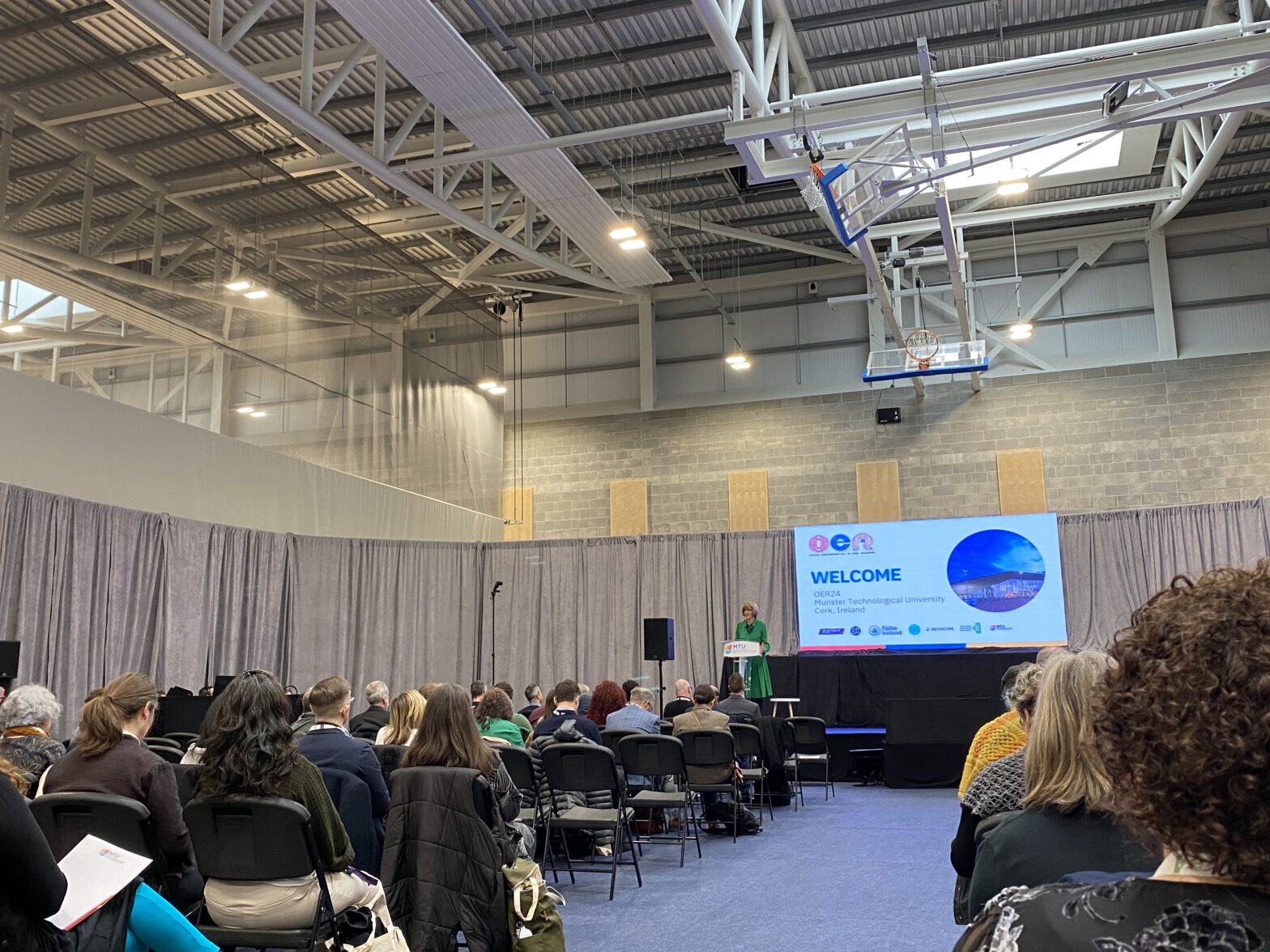
It has been five years since I attended an international Open Educational Resources-(OER)-Conference, this time in Cork, Ireland and perfectly organized by Munster Technological University.
Two days with a full-packed program including the GASTA-format. According to ChatGPT GASTA is
„(…) an Irish (Gaelic) word that can have different meanings depending on the context. Generally, it is translated as „quick“ or „swift“. It can refer to the speed or haste of a movement or action. In some contexts, it could also be used as an adjective or adverb to describe something that is quick or swift.
Without a specific context, it is difficult to give a more precise meaning, as the meaning can depend heavily on the context in which the word is used.
ChatGPT
In the context of #OER24, GASTA contained short presentations which were accompanied by some sort of collective battle cry to signal either the start of a new session or that the end of the current session is near (see for example at 30:27 in this video).
There were also two inspiring keynotes by Rajiv Jhangiani and a collective one by Catherine Cronin and Laura Czerniewicz in which they shed light on the overall, mostly depressing picture of the current state of Higher Ed.
Both keynotes decided to raise questions about the future destiny of Open Education, i.e. either going down the dystopian road of „crack-up capitalism“ or trying to revitalize the old promises of the original Internet (e.g. fediverse, i.e. a network of federated, independent social networks, microblogging services and websites for online publication or data hosting).
Rajiv pointed out that the OER-community tends to tell themselves a hero story how OER can overcome the obstacles in Higher Ed and foster social justice, equity and inclusion. On the other hand there are the hard facts of realty such as this example shows: 25 Years Without a Raise. And of course the effects of the notoriously enormous tuition fees cannot be overstated. During lunch break, I talked to an attendee who is still paying for her Bachelor degree which she got back in 1999. Against this background, the efforts to provide such things as zero cost degrees are a success story for the Open-Education-community. Given the attempts of the publishing companies to spy on students using textbooks that read you, it should be clear that much more effort is needed.
It is from this perspective that I was expecting stronger claims for a better future, in particular what the next concrete steps might be. Catherine and Laura urged us to re-think the goals of Open Education in the context of multiple crises and provided a helpful review of recent attempts.
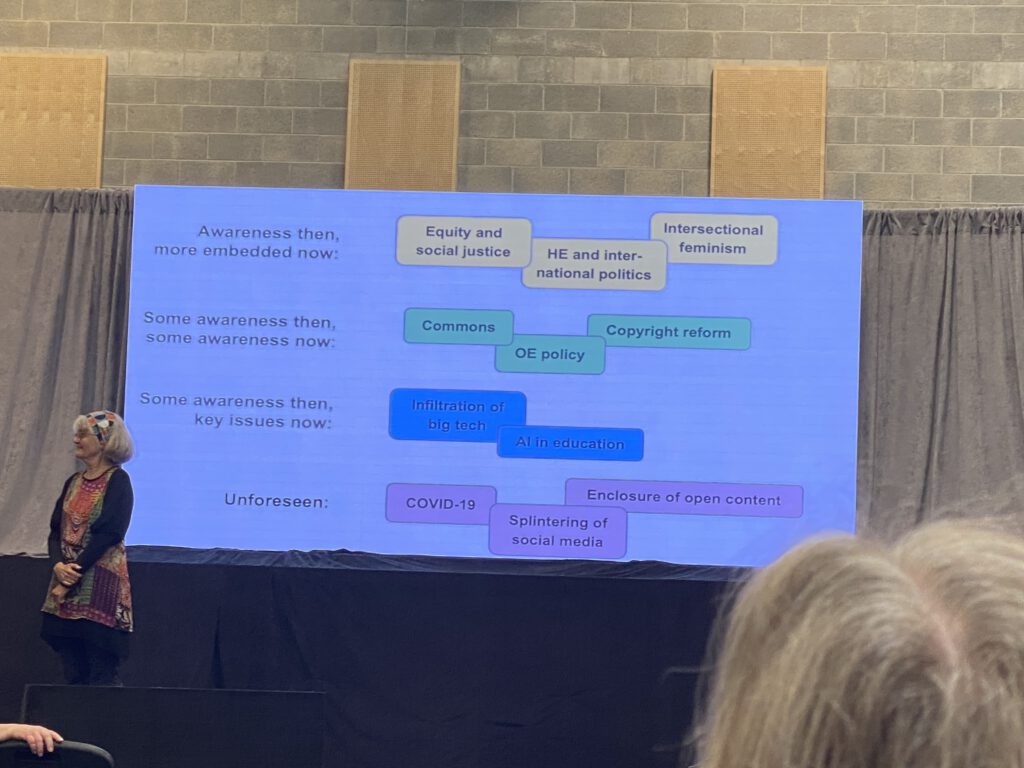
However, given all these crises and challenges for society and for Higher Ed in particular, I got the impression that the Open-Education-community might overstrain themselves because of a missing overall roadmap /agenda that can help guide the work on the various levels in the educational system. As one participant said, openness means different things for different people. This has also become apparent in some presentations because they contained little obvious connections to the overall Open-Education-movement (which could mean that as a community we should put more effort in agreeing on a common agenda). One step could be to establish a corpus of Open-Education-literature (if this already exists, please let me know).
On an abstract, normative level, there is agreement that we should strive for more equity, social justice and inclusion in education. But concerning the means, there seems to be less agreement.
Nevertheless, I greatly enjoyed the conference. Following are some personal highlights:
- tremendous work by the unconquerable Martin Weller by looking back to 25/30 years of Ed Tech and deconstructing the narratives
- eCampus Ontario presented a new license (Ontario Commons License)
- the Developing Open Educational Resources (DOERS) project
- the Institutional Self-Assessment Tool for OEP
- Higher Education, can you hear us? Amplifying student voices from Oklahoma State University
- Post-digital Learning spaces TU Dublin
- Catalogue of French OER with the indispensable Metadata
- Unlocking OER for Public Libraries
